

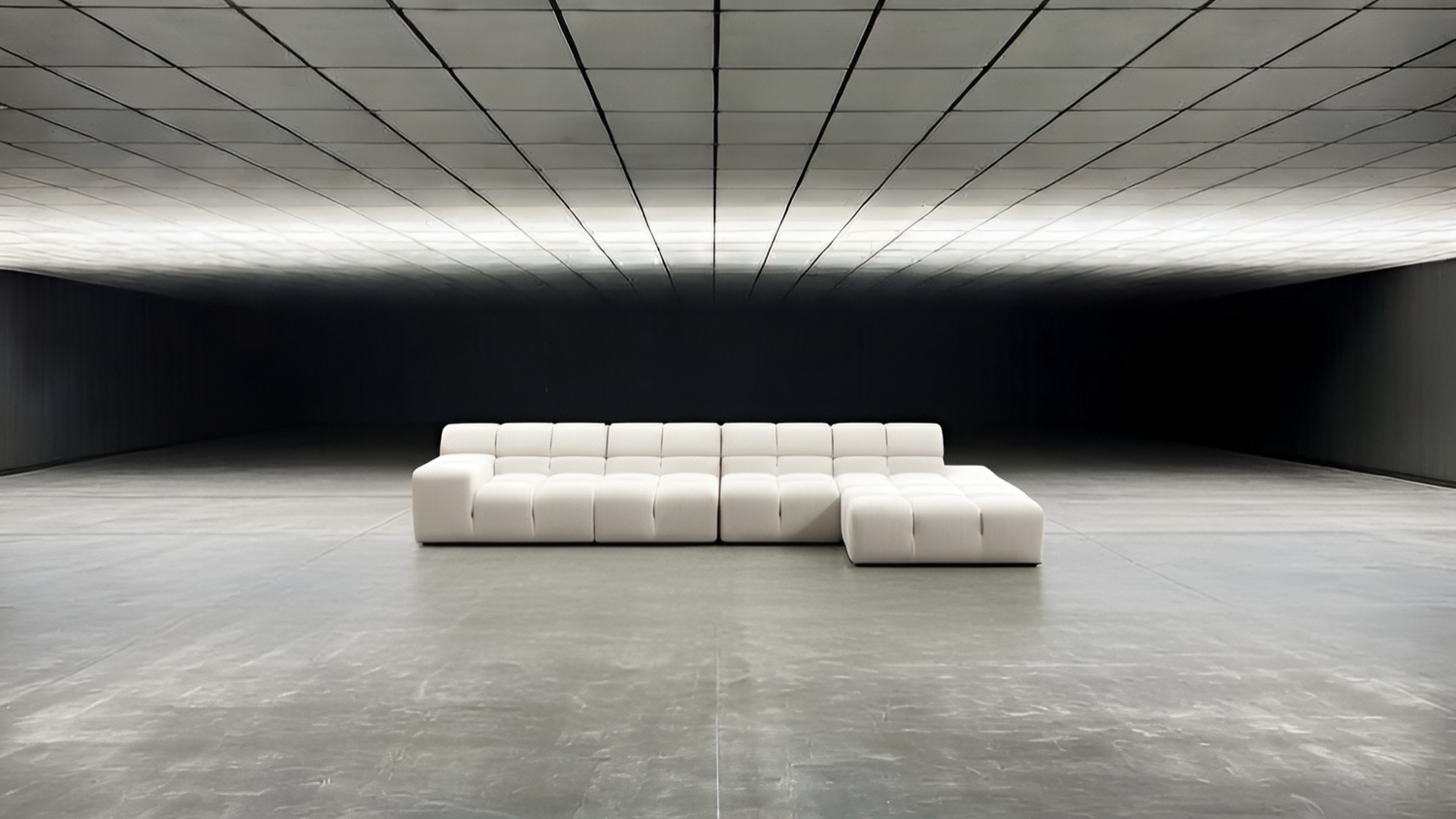
Imagine stepping into your living room after a long day and finding a piece of furniture that goes far beyond just inviting you to sit — it subconsciously offers to wrap you up and take the weight of the world off your shoulders. It looks like a grid of oversized, tufted blocks, plush and inviting, almost like a sleeping bag scaled up for adult life. This design wasn’t accidental.
It’s the legacy of a moment when Pop Art met everyday comfort, and a handful of Italian designers decided that furniture could do more than hold your body. It could contain it. The question that lingers, decades later, is simple: why does sinking into one of these sofas still feel like such a profound relief?
From 60's Institutional Coldness to Plush Refuge
By the late 1970s, the American interior had begun to resemble the culture that produced it. This was an era marked by war anxiety, protest culture, institutional paranoia, institutional distrust, and a growing sense that public authority was opaque, punitive, and always watching.
That atmosphere did not stay outside. It showed up indoors—in schools, offices, hospitals, waiting rooms, and civic buildings—through hard chairs, cinder-block walls, metal desks, fixed seating, linoleum floors, and layouts that emphasized order over ease. Rooms looked managerial: fluorescent lights, strict rows, blank walls, metal frames, synthetic surfaces.
The body was expected to sit upright, stay alert, and take up as little physical space as possible. Against that backdrop, a different order began to emerge—one organized around protection, ease, and the possibility that a room might hold you rather than manage you.

As that shift took hold, the soft padded interior became more than a visual trend and more than a rejection of formal modernist seating. Across the 1960s and 1970s, designers were producing deeper sectionals, modular floor systems, quilted upholstery, conversation pits, zippered seating elements, and low-slung furniture built around flexibility and bodily ease. These pieces changed how interiors were physically used. They lowered the body, reduced the dominance of the rigid frame, and introduced new forms of lounging, reclining, clustering, and territorial arrangement.
Softness was no longer confined to decorative upholstery; it became structural, spatial, and immersive. As this language spread through domestic and commercial interiors, it also became easier for theorists and researchers to treat comfort, enclosure, support, and visibility as serious environmental conditions rather than matters of taste.
This is the point where design expression and environmental study begin to meet: the rise of padded, modular furniture created not only a new interior aesthetic, but a new set of questions about why certain spaces feel protective, inhabitable, and psychologically reassuring.
Robert Sommer & Helge Olsen's Study "The Soft Classroom"

Robert Sommer, an influential American psychologist and Distinguished Professor at UC Davis, built his reputation on the study of personal space, classroom layout, and the behavioral effects of built environments. His research helped establish environmental psychology as a serious field of inquiry by examining how institutions, from hospitals to libraries to classrooms, organize social behavior through design.
Helge Olsen, a design lecturer at UC Davis, was known for his interest in furniture, children’s toys, and playground design—areas concerned with how form, comfort, and movement shape human experience.
Sommer and Olsen began with a conventional university classroom they described as drab, sterile, and institutional. They remade that academic interior in physical terms, replacing standard classroom conditions with semicircular cushion-covered bench seating, carpet, fabric wall coverings, and adjustable lighting. Rather than asking students to speculate about comfort in the abstract, they changed the room itself and observed student response to the redesigned space.
In the room’s opening days, they gathered informal responses in two ways: observers stood near the entrance and wrote down remarks students made as they entered, while graffiti pads placed inside and outside the classroom invited written comments. Those responses were collected daily for about a week. About a month later, with instructors’ permission, observers sat in on classes and recorded classroom interaction during ten one-hour sessions. Several weeks after that, the researchers administered a written questionnaire to the classes using the room.
The results were direct. Students showed higher participation, greater comfort, and stronger engagement, while the classroom’s cold institutional feeling disappeared. The cushions created a psychological sense of permission to relax, take up space, and feel supported by the room itself. The padded surfaces gave the space a holding quality, making the environment feel less corrective and more accommodating to the body.
Revisited again 17 years later, The Soft Classroom remains rare archival evidence from 1980 that padded, grid-like cushioned interiors were already being connected to comfort, participation, and the mental experience of space.
Jay Appleton's Prospect-Refuge Theory (1975)

Jay Appleton, the British geographer best known for developing Prospect-Refuge Theory, published The Experience of Landscape in 1975 as a way of explaining why certain environments feel instinctively right to people. His core idea was straight forward: humans are drawn to environments that offer both prospect open view, surveillance, and possibility, or the ability to look out and understand what is around them—and refuge—protected enclosure, safety, and the feeling of being held.
That framework is unusually useful for reading padded modular seating in the 1970s. Deep, quilted, zip-in cushions deliver refuge in literal bodily terms: they create backing, absorb pressure, soften the perimeter of the body, and produce the sensation of being surrounded rather than merely seated.
A piece like Strips or Camaleonda does not just offer upholstery; it offers containment. You can lean into it, sink into it, rearrange it, and in some cases almost climb into it. That physical condition matters. The body is not left hovering on the edge of a hard frame or perched against an upright formal structure. It is received, buffered, and partially enclosed. Through Appleton’s lens, that is refuge translated from landscape into domestic form.
The modular grid becomes just as important, because it keeps the seating from collapsing into pure retreat. Even while wrapped by cushioning, the sitter can still orient outward, hold a view across the room, and mark territory within a larger shared interior. That balance—containment without disconnection, softness without spatial surrender—is exactly what makes Appleton so relevant here.
The emotional directness of 1970s padded sofas helps explain Appleton’s theory in why wrapping, body-conscious seating felt so persuasive in a decade preoccupied with stress, distrust, and institutional coldness. These pieces staged refuge at the scale of the body. They offered a protected interior- inside the interior: a place to settle, spread out, and feel cocooned and protected by the environment while still remaining visually aware of the room around you.
The theory traveled quickly because it gave designers a precise language for describing why some spaces feel exposed and others feel instinctively inhabitable. He returned to the idea in 1984, but the 1975 book is the original statement and the key text. That is why The Experience of Landscape remains such a useful framework for this moment in design history in how padded, grid-like modular seating could feel psychologically restorative not simply because it was soft, but because it spatialized security.
From Strips to Camaleonda: The Rise of Quilted Sofa Design

By the late 1960s, Pop Art had already elevated soup cans, comic strips, and everyday consumer goods into cultural icons, while artists like Christo and Jeanne-Claude were wrapping buildings, monuments, and landscapes in fabric, turning familiar forms into tactile spectacles; Italian designers absorbed that visual language and redirected it toward the home, asking what would happen if furniture borrowed from the logic of bedding, garments, and packaging, making comfort something you could zip into, sink into, and physically inhabit.
1968: Cini Boeri develops Stripsfor Arflex, a modular system of seats, sofas, and beds built from molded polyurethane and removable quilted covers.
1970: Mario Bellini introduces Camaleonda for C&B Italia, later B&B Italia, using 90-by-90-centimeter capitonné-tufted modules connected by cables, hooks, and rings to create a reconfigurable, body-conscious sofa system.
1972: Camaleonda is included in MoMA’s Italy: The New Domestic Landscape, helping cement its status as a landmark in the shift away from harder, earlier modernist seating.
1979: Stripswins the Compasso d’Oro, recognizing its emotional immediacy, industrial practicality, and radically soft approach to modular furniture.
2005: Patricia Urquiola revisits and extends this lineage with Tufty-Timefor B&B Italia, carrying forward the quilted, modular, body-aware sofa language into the 21st century.
Present day: That same design DNA continues in pieces like the Mario Capasa Amora Sectional, which translates the Pop-informed, quilted, modular tradition into monoblock expanded foam units, seamless connections, sculptural volume, and cocooning softness.
The Psychology of a Monobloc Sofa
 Psychologically, the appeal goes deeper than physiology. Full-body enclosure taps into early experiences of being held and protected — feelings that many of us associate with security from childhood onward. The era’s key thinkers did study the mind-body impact of soft, cushioned, rearrangeable, womb-like enclosures — exactly the tactile “garment” and territory-shaping feeling your sofas create.
The comfort of being wrapped, the security of enclosure, the playfulness of shaping your own refuge. More than just the softness of wrapping yourself in shelter, it gives you the permission to disappear for a moment. In uncertain times, that kind of containment feels less like indulgence and more like a necessary reset. The modular system adds another layer: you actively shape your own environment, rearranging blocks to claim space and define your territory.
The Body and The Plush Couch
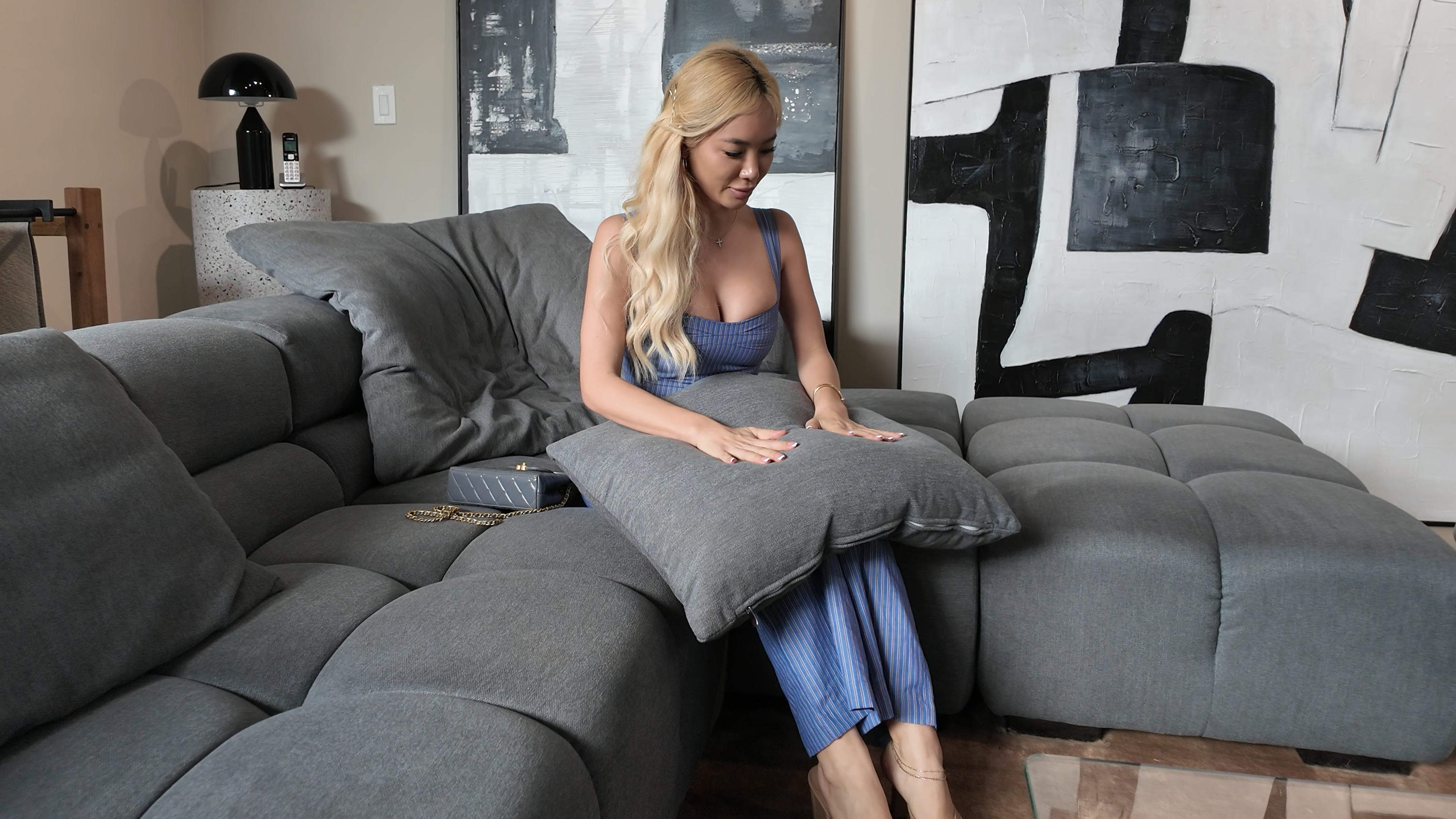
 Step away from the design intentions entirely, and the body’s response to these surfaces becomes its own story. The even, distributed compression from the tufted foam and quilted layers provides what researchers refer to as deep pressure stimulation.
Independent studies on similar inputs — weighted blankets, compression garments, or firm hugging — have documented measurable shifts: heart rate slows, cortisol levels decrease, and activity in the parasympathetic nervous system increases. The nervous system registers the pressure as a signal of safety, moving the body toward a rest-and-digest state. This is biology at work, separate from any aesthetic choice.
The monoblock foam construction in pieces like the Amora maintains that consistent pressure no matter how you position yourself. Every square offers its own pocket of support. Science illuminates why the sensation registers so reliably across decades.
The Lasting Appeal of the Padded Grid Sofa
 Across this history, the padded grid emerges as a cultural technology of relief. Its power sits in the way quilted foam, monobloc construction, and modular depth reorganize the relationship between body and room. What follows is a rare kind of interior experience: support that reads immediately, enclosure that calms without closing the room down, and softness that gives physical form to security.
In 2026, this is also just as significant, We currently live in an era of constant input — screens, open-plan spaces, the blurring of work and home. Against that backdrop, a quilted modular sofa offers something increasingly rare: a deliberate counterpoint. It isn’t about escaping the world. It’s about creating a small, reliable zone where the body and mind can recalibrate. The form keeps resurfacing because it answers a need that doesn’t go away — the human desire for tactile comfort that feels both modern and timeless.
The Amora by Mario Capasa sits squarely in that lineage. Its plush, cube-like cushions and oversized depth turn any space into a generous gathering spot or personal retreat. It’s practical, reconfigurable, and unapologetically comfortable — a design investment that pays out in daily ease rather than just looks. From the radical experiments of the 1960s to today’s living rooms, these pieces remind us that sometimes the most forward-thinking furniture is the one that simply lets you sink in and feel held.
The rabbit hole goes beyond theoretical. It’s plush, modular, and already waiting. Sink in. The world outside the grid can wait a little longer.

Leave a comment
This site is protected by hCaptcha and the hCaptcha Privacy Policy and Terms of Service apply.