

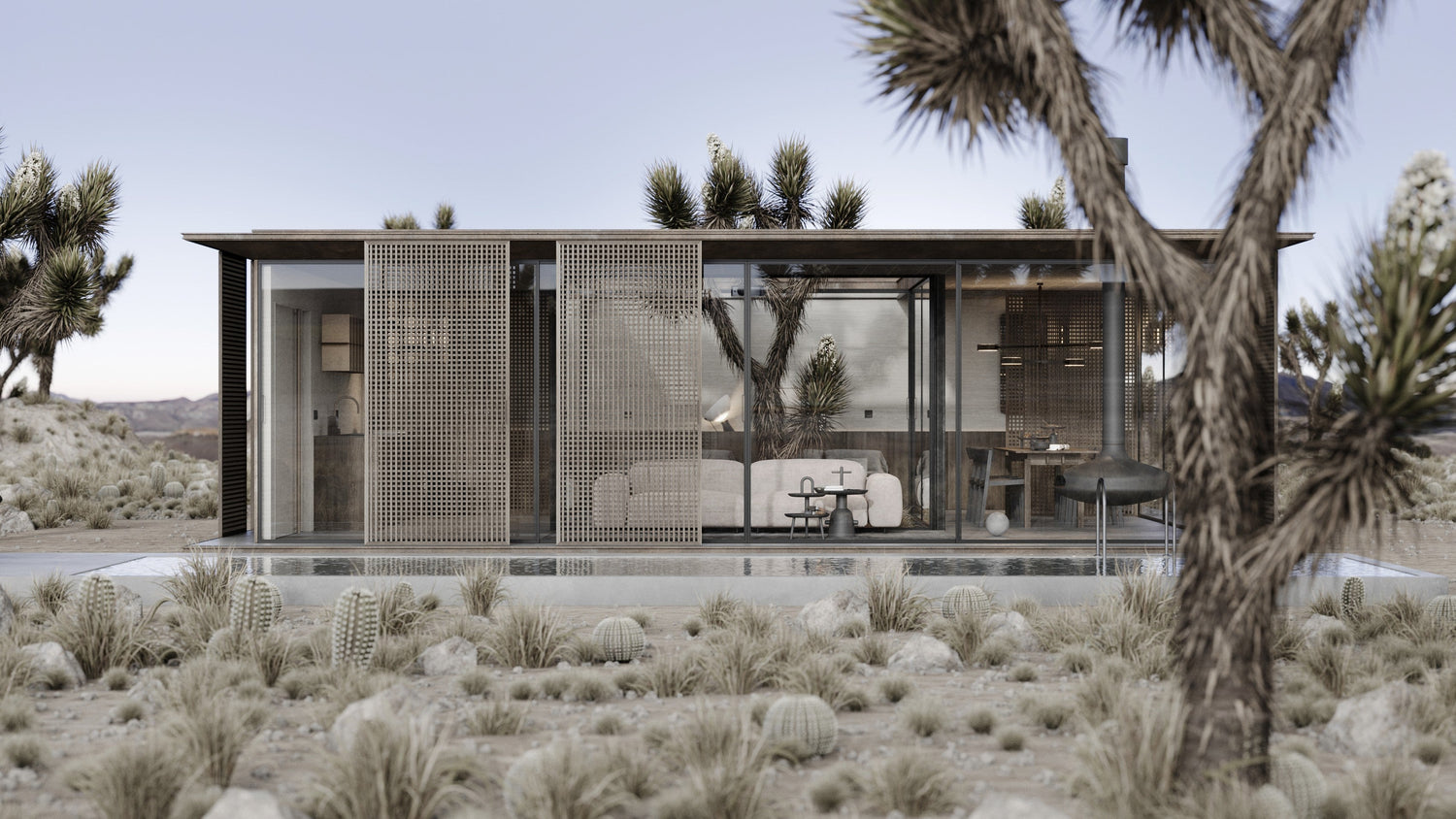
The drive into Joshua Tree has always felt cinematic — a procession past abandoned gas stations, weather-beaten signage, and the kind of sun-bleached architecture that seems to evaporate into the Mojave. By the time you reach the last turnoff, the desert has already stripped the built world down to its essentials: sky, stone, and the improbable geometries of rotting barns and midcentury cabins.
Against this backdrop, the cabin doesn’t compete for attention. It recedes. A low horizontal form with glazing wrapped like film stock around the frame. From a distance it reads as a mirage or a minimalist sketch — a gesture closer to Marfa’s land art installations than a conventional vacation rental.

Inside, the floor drops you into a composition that feels equal parts organic modern, Japandi restraint, and soft brutalism, but without the austerity. The furnishings sit low, almost shy of the horizon line, allowing the desert to enter the room as if it were another material. Sand, timber, taupe, iron, and glass — a palette tuned to what the light does at 4:12 p.m. in late winter.
For those who’ve tracked the evolution of desert modernism — from Neutra’s Kaufmann House to the Morongo Basin’s more recent wave of high-design micro hotels — this cabin situates itself in an emerging category: hospitality-grade residential architecture, where the private home is engineered for both intimacy and transience, and where interior design behaves as a service layer rather than ornamentation.
The bedrooms operate like boutique hotel suites — not in the decorative sense, but in how they anticipate behavior. Lighting at reachable heights, integrated millwork instead of freestanding storage, and bathrooms treated as miniature spas rather than utilities. The living areas follow another hospitality logic: modular seating, performance textiles, and layouts that can quietly adapt for families, retreats, photo shoots, or weeklong sabbaticals from city life.
What distinguishes the project — and what makes it genuinely escapist — is the lack of hierarchy between inside and out. The patio isn’t an amenity; it’s the second living room. The fire pit isn’t an accessory; it’s the evening dining room. Glass slides open, screens shift, and suddenly the Mojave is in dialogue with whatever you’re cooking, reading, or writing. It’s architecture as climate, and interior design as choreography.

Inside, the cabin reads like a study in warm minimalism and desert modern hospitality. The living room is arranged around a low-profile modular sectional in taupe microfiber, with a silhouette that nods to Italian modern upholstery. The seating height sits at roughly 15 inches, keeping the sightline below the glazing and allowing the Mojave to act as a living mural. It’s the kind of piece that qualifies as a design-forward mood board centerpiece—more editorial than decorative, built for lounging rather than posturing.
A solid oak coffee table sits at calf height, its blocky geometry echoing the quiet assertiveness of soft brutalism. This isn’t brutalism as concrete worship; it’s brutalism translated for a hospitality interior—rounded corners, oiled surfaces, no sharp edges, no reflective veneers. The combination of softness and structure makes the room feel like a luxe lounge for readers, remote workers, and late-night conversations rather than a vacation rental living room.
Along the glazing, a slim console in matte black steel and oak veneer introduces a whisper of Belgian minimalism, the kind seen in Antwerp apartments and boutique hotels. It holds nothing—no vases, no staging props, no art books—because the desert is doing the work that objects usually do in urban apartments.

The dining area leans toward Japandi and New Nordic restraint. A rectangular ash dining table with radiused corners sits on inset legs, paired with two low dining chairs and a long backless bench. The proportions recall Muji-inspired minimalism without falling into pastiche. Lighting is handled by a recessed linear LED strip instead of pendants—avoiding visual clutter and reinforcing the International Style instinct that function and clarity should determine form.

Kitchen and Dining: Functional Minimalism
The kitchen interior design follows the same logic of reduction. Cabinetry is flush and integrated, hardware minimal, surfaces durable and tactile. Appliances are concealed within dark-stained millwork, allowing the kitchen to read as part of the architecture rather than a separate zone. The dining table is solid, rectilinear, and unadorned, positioned to align with the building’s structural grid.
This is not decorative minimalism, but operational clarity—an approach often seen in contemporary interior design projects where longevity and ease of use matter as much as visual impact.
In the kitchen, the cabinetry adopts a contemporary California palette: matte sand laminate, concealed pulls, and a porcelain slab counter in off-white stone. The appliances are panel-ready and nearly invisible, like the service areas of luxury boutique hotels or private villas in Mexico City and Copenhagen. Overhead, the soffit lighting casts an even wash that feels more gallery than home, turning food prep into a kind of quiet stage.

The bedrooms operate with hotel logic. Platform beds upholstered in linen blend sit low to the floor, flanked by walnut veneer cube tables. The headboard wall is wrapped in fabric panels that borrow from Parisian modern and contemporary classic hospitality suites—not ornate, but complete. Bedding stays within a monochrome minimalism palette: flax, ivory, beige. A built-in millwork wall provides storage without handles; a detail lifted straight from Danish modern cabinetry and minimaluxe residential design.

The bathrooms lean toward organic modern spa culture. Floating oak vanities support matte trough basins, with wall-mounted faucets inspired by Milanese hotel bathrooms of the early 2000s. The shower uses frameless glass, a fixed rain fixture, and clay-toned tile underfoot. A clerestory window above pulls in oblique morning light that feels closer to a Zen modern ryokan than a typical rental.
Outside, the lounging deck operates as a second living room. Weather-rated upholstery in earth tones surrounds a rectangular concrete fire pit that channels soft brutalism again, while a recessed soaking tank faces the valley like a private futuristic lounge installation—part Scandinavian sauna culture, part space-age minimalism, part desert ritual. At night, landscape lighting at 3,000K keeps the rocks legible without bleaching them, preserving the drama of the darkness.

A Modern Desert Cabin in Joshua Tree
From a distance, the cabin reads as a horizontal trace against the desert—low, planar, and deliberate. Set within the high-desert terrain of Joshua Tree, it does not announce itself as an object, but as a calibrated interruption: glass, concrete, timber, and perforated screens arranged to frame sky, stone, and shadow. The approach is quiet, architectural, and intentional—less a retreat from the landscape than a negotiation with it.
This project was conceived as a hybrid space: a personal luxury home that functions equally well as a short-term rental, a boutique hospitality prototype, and a flexible investment asset. Its design language draws from modern home interior design and residential interior design principles, but it is executed with the rigor typically reserved for hospitality interiors. The result is a structure that performs across use cases without aesthetic compromise.
Architecture Shaped by Climate and Terrain
Joshua Tree offers no neutral conditions. The site’s aridity, temperature swings, and open exposure demanded a home interior design modern approach grounded in performance as much as form. The structure is elevated slightly above grade, allowing airflow and water movement beneath while preserving the natural slope of the land. Floor plates remain compact and efficient, reducing thermal load while maintaining long sightlines through the glass perimeter.
Exterior walls alternate between solid planes and semi-permeable screens, softening the boundary between inside and out. This layered envelope recalls contemporary interior designs that favor permeability over enclosure, allowing light, air, and shadow to act as active design elements rather than afterthoughts.

Interior Design as Spatial System
Inside, the interior of design is restrained and disciplined. Concrete floors are left matte and cool, grounding the space visually and thermally. Built-in millwork replaces freestanding furniture wherever possible, reinforcing clarity and reducing visual noise. The palette stays within a narrow band of mineral tones—stone gray, weathered oak, charcoal metal—allowing texture and proportion to do the work traditionally assigned to color.
This is residential interior design executed with hospitality logic. Circulation is deliberate, furniture placement precise, and every zone—living, sleeping, bathing—reads as part of a continuous spatial sequence. Rather than dividing rooms with walls, shifts in ceiling height, material, and light signal transitions. It’s an approach increasingly favored by interior designers working across both residential and hospitality projects.
Living Spaces Designed for Adaptability
The primary living area functions as both private lounge and communal gathering space. Seating is low-profile and modular, scaled for long stays rather than short visits. Large-format glazing dissolves the boundary to the exterior, turning the desert into a constant visual companion. During the day, the space operates as a light-filled retreat; at night, it contracts inward, defined by shadow and carefully calibrated artificial light.
This adaptability is critical for interior home environments that serve multiple audiences. Whether occupied by a single owner or rotating guests, the space remains legible, calm, and intuitive qualities increasingly prioritized by interior designers near me working on high-end rental and investment properties.
Bedrooms as Private Refuges
Sleeping quarters are intentionally understated. Bedroom interior design here prioritizes proportion, acoustics, and light control over ornament. Built-in headboards double as storage and shelving, reducing the need for additional furniture. Windows are placed to frame specific desert views while minimizing direct solar gain, creating rooms that feel protected without becoming insular.
For a property that functions as both home and hospitality asset, this balance is essential. Guests experience comfort and calm, while owners benefit from interiors designed to withstand frequent use without degradation.
Bathing Spaces and Material Honesty
Bathroom interior design continues the project’s material discipline. Stone walls are left subtly textured; fixtures matte and tactile. Vanities are custom-built, integrated into the architecture rather than applied afterward. Natural light enters indirectly, bouncing off surfaces rather than flooding the room, reinforcing a sense of enclosure and privacy.
These spaces reflect a broader shift in modern interior designs toward sensory restraint—spaces that encourage slower use and heightened awareness rather than visual stimulation.

A Turnkey Design and Furnishing Approach
The project was delivered through a turnkey interior design and furnishing process, integrating architecture, interior design services, custom millwork, and furniture procurement into a single workflow. This approach is increasingly sought after by developers and investors looking for interior design firms near me that can manage complexity without fragmenting responsibility.
By handling design, fit-out, and furnishing as a unified system, the project avoids the inconsistencies that often arise when architecture and interiors are treated as separate disciplines. The result is a cabin that reads as complete resolved from structure to detail.
A Prototype for Desert Hospitality
As a model for boutique hospitality properties and high-end short-term rentals, the Joshua Tree cabin demonstrates how residential interior design can operate at a hospitality standard without adopting the tropes of hotel design. There is no excess branding, no decorative signaling. Instead, the value lies in spatial intelligence, material integrity, and adaptability.
In a market increasingly saturated with surface-level luxury, this project offers an alternative: a modern desert cabin where interiors and designs are inseparable from architecture, climate, and use. It’s a quiet proposition—but one that speaks clearly to developers, operators, and design professionals attuned to the future of residential and hospitality interiors.

Leave a comment
This site is protected by hCaptcha and the hCaptcha Privacy Policy and Terms of Service apply.